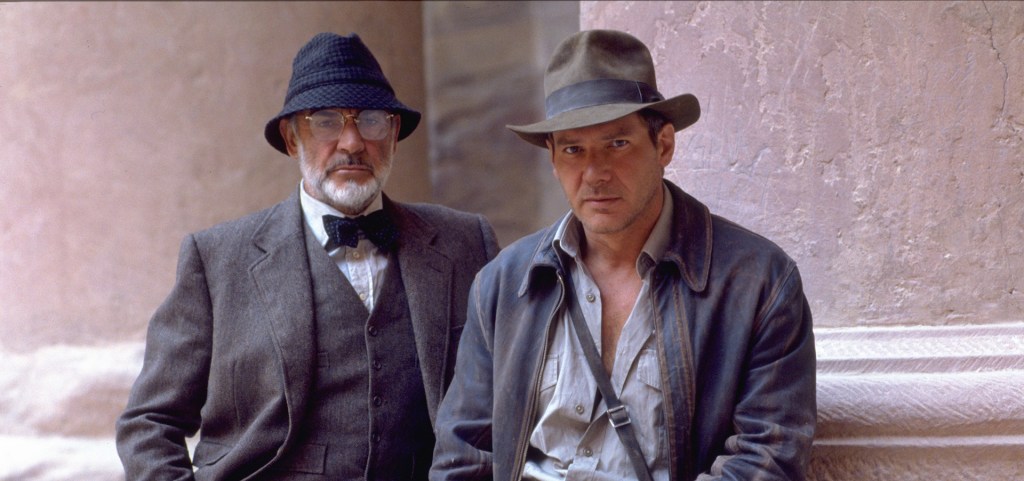
In what may be the first of a series, I would like to talk about Biblical Archaeology in Pop Culture, and what better place to start than the most famous fictional archaeologist ever, Dr Henry ‘Indiana’ Jones Jr? As someone studying Archaeology in Palestine, I come to Indy again with another perspective. Here are some quick thoughts about Indy in relation to Biblical Archaeology.
The first Indy film I ever saw was “The Last Crusade” (1989) and it remains my favourite even though “Raiders of the Lost Ark” (1981) might technically be ‘better’. Both films represent Biblical Archaeology in the 1930s as carried out westerners in an imperial context – it is notable that in all the films the locals play a small part, relegated to silhouetted background workers on large dig sites, or the the token trusted, wise ‘oriental’, such as Sallah.
The setting of the 1930s, which can be seen as the hey day or ‘golden age’ of Biblical archaeology (Moorey 1991), the use of archaeology to gain political power, the conflict of faith vs science, and the management and legislation around antiquities (for example, do they belong in a museum?and If so who’s museum?) – these are all themes I explore in my work, and these are all present in both Raiders and Last Crusade.
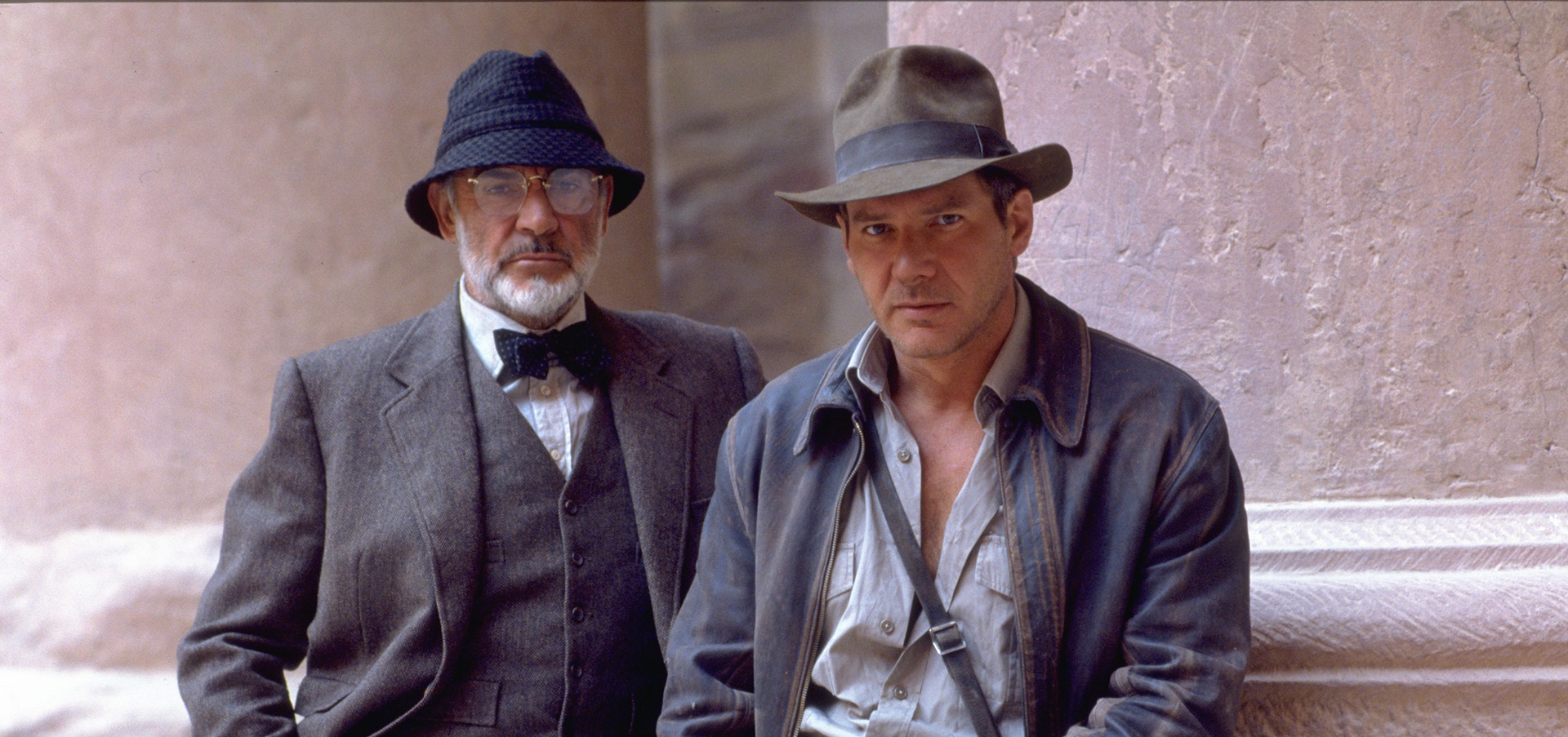
I find the two generations of Jones scholars in the Last Crusade especially interesting. At the time the film is set (the 1930s) archaeology was becoming increasingly professionalised and scientific, it was the ‘Golden Age’ of Biblical Archaeology (Moorey 1991). This drive towards a more objective, scientific approach can be seen in Indy the ‘scientist’ (albeit one with very dubious methods!), who states “Archaeology is the Search for Fact not Truth”
Henry Jones Sr, the Biblical scholar and man of faith represents the older generation; he does not separate his faith from his work, indeed he cannot – it is all part of the same personal and spiritual quest. Talking about Elsa’s (who was working for the Nazis in the film) motivation for the search for the grail he states:
Professor Henry Jones:
Elsa never really believed in the grail. She thought she’d found a prize.
Indiana Jones:
And what did you find, Dad?
Professor Henry Jones:
Me? Illumination.
This resonates with the earlier generation of archaeologists who’s faith (usually Christian) was often a motivation for their archaeology and the two cannot be easily separated in their work, particularly in the earlier days, as American archaeologist F J Bliss states :
Now, you know this is the Holy Land. Abraham, Isaac, Jacob, David and Solomon lived here, and it is a matter of religion to come and unearth their towns and find out how they lived, and what they did, if we can. Now, I don’t expect you to believe me, but I am telling you the truth when I say that the purpose of the digging is not treasure, but one of religion
F J Bliss 1894 “Mound of Many Cities” 170-171
How we think about ‘cultural heritage’ was changing during this time, with museums and education becoming preferred over the private collection (Cook 1988: 139), this is echoed in Indy’s most famous refrain “That belongs in a museum!”. The Nazi’s quest for power by securing important artefacts such as the Ark or the Grail can be read as (a very dramatised and hollywoodised) parallel for the “archaeological arms race” of the late 19th and early 20th century, in which western nations competed to outfit their museums with the most important finds, and place themselves as rightful heirs to the great cultures of the past (Goff 2005), (Challis 2008), (Díaz-Andreu 2007). Furthermore archaeology was a great cover for espionage (Richter 2008) and many archaeologists were involved in ‘extra curricular activities’, such as Indy being recruited by the government.
The ‘character’ of the Archaeologist as brave adventurer on romantic quests is one that was present at the time, and was often used by archaeologists themselves as part of ‘scripting of spadework’ (Thornton 2018). Indeed George Lucas has acknowledged the strong influence of 1930s pulp comic and movie characters on Indy, as well as the influence of real archaeologists such as Leonard Woolley.
So whilst the Indy films are far from realistic, they do represent some dominant themes in the history of archaeology, in particulate Biblical Archaeology and the search for “Fact” vs the Search for “Truth”. And of course, X never, ever marks the spot.
References
Bliss A Mound of Many Cities: Or, Tell El Hesy Excavated. Vol. 12. Committee of the Palestine exploration fund, 1898. – available online https://archive.org/details/cu31924028592206/
Cook 1998. “British Archaeologists in the Aegean.” In Brand. V, ed. The study of the past in the Victorian age. pp. 139–154.
Challis 2008 From the Harpy Tomb to the Wonders of Ephesus: British Archaeologists in the Ottoman Empire 1840–1880
Díaz-Andreu 2007 A World History Of Nineteenth-Century Archaeology : Nationalism, Colonialism, and the Past.
Goff 2005 Classics and Colonialism.
Moorey 1991 A History of Biblical Archaeology
Richter 2008 “Espionage and Near Eastern Archaeology: A Historiographical Survey.” Public Archaeology 7, no. 4 (2008): 212–40.
Thornton 2018 Archaeologists in Print available online: http://discovery.ucl.ac.uk/10050677/
 Chloe Emmott
Leave a comment